











Introduction
Bionetting is much more than just cleaning: it's a rigorous process that combines cleaning and disinfection to reduce biological contamination of surfaces. Unlike conventional cleaning, this method is specifically aimed at eliminating pathogenic micro-organisms to prevent the spread of infection. If you work in the healthcare or pharmaceutical industries, or would like to understand advanced hygiene principles, a knowledge of bionetting is essential.
This method is particularly used in sensitive environments where the proliferation of micro-organisms must be kept to a minimum. These include hospitals, clinics, doctors' surgeries, retirement homes, nursing homes and research laboratories. The fundamental principle of bionetoyage is based on Sinner's circle of 1959, which states that effective cleaning action results from the combination of four equally important factors. In this article, you'll discover the precise definition of bio-cleaning, its fundamental principles, and the protocol to follow to ensure a clean environment free from contamination.
Definition of bio-cleaning and context of use
Bio-cleaning is a set of procedures that combine thorough cleaning with disinfectant action. This method aims to maintain optimum hygiene levels while significantly reducing the presence of micro-organisms. Contrary to popular belief, bio-cleaning is not limited to the removal of visible dirt, but also tackles contaminants invisible to the naked eye.
In France, bio-cleaning is governed by various standards and protocols, particularly in healthcare establishments where it is an integral part of daily hygiene procedures. The term «bio» does not refer to an ecological method, but rather to action against potentially dangerous biological elements such as bacteria, viruses and other pathogens.
The difference between conventional and bio-cleaning
Conventional cleaning and bio-cleaning differ fundamentally in their objectives and methods. Firstly, traditional cleaning focuses primarily on aesthetics and the removal of visible dirt. It aims to make surfaces appear clean, without necessarily eliminating the micro-organisms present.
Bio-cleaning, on the other hand, goes beyond this superficial approach. This method comprises two essential phases:
- Detergency phase: eliminates visible soiling and the majority of micro-organisms present
- Disinfection phase: destruction of remaining micro-organisms to achieve a high level of hygiene
Another major difference concerns the equipment and products used. Whereas conventional cleaning can make do with standard household products, bio-cleaning requires specific products that meet strict standards of antimicrobial efficacy. What's more, bio-cleaning protocols include rigorous organization to prevent recontamination of treated areas.
In addition, bio-cleaning personnel must undergo specific training, including appropriate techniques and knowledge of the risks of cross-contamination. These special skills are not generally required for conventional cleaning.
Why bio-cleaning is essential in sensitive environments
In some environments, visual cleanliness alone is not enough to guarantee the safety of occupants and processes. This is particularly the case in healthcare environments, where bio-cleaning plays a crucial role in the prevention of hospital-acquired infections, These hospital-acquired infections affect around 6% of hospitalized patients in France every year.
Healthcare establishments such as hospitals, clinics and nursing homes are particularly vulnerable environments, where vulnerable people and potentially dangerous pathogens cohabit. In these contexts, bio-cleaning becomes an indispensable part of the care and prevention chain.
However, the importance of biocleaning also extends to other sensitive sectors. In the agri-food industry, for example, this method enables compliance with the strict hygiene standards required to avoid contamination of products intended for consumption. Similarly, research laboratories, day-care centers and facilities for the immunocompromised benefit greatly from bio-cleaning protocols.
It should be noted that the effectiveness of bio-cleaning also depends on its regularity and adaptation to the specific features of each environment. An appropriate protocol must take into account the frequency of use, the types of activities taking place and the specific risks identified.
In short, bio-cleaning is much more than a simple cleaning procedure; it's an essential link in the chain of health prevention in sensitive environments, contributing directly to public health and the safety of vulnerable populations.
The fundamentals of biocleaning
For effective bio-cleaning, it is essential to master certain fundamental principles governing this professional hygiene practice. These principles are not simply recommendations, but form the scientific basis for optimum results in eliminating micro-organisms.
The Sinner circle: time, action, chemistry, temperature
At the heart of bionetting is the Sinner Circle, a concept developed by German chemist Herbert Sinner in 1959 while working for the Henkel company. This theoretical model explains the four equally important factors that determine the effectiveness of professional cleaning:
- Temperature: facilitates the dissolution of dirt and reinforces the action of products. A high temperature accelerates chemical reactions and helps to dissolve grease and other residues more effectively.
- Mechanical action: This refers to the physical energy applied to the surface, such as friction or pressure, to dislodge stubborn dirt.
- Chemistry: This concerns the products used (detergents, disinfectants), which play a crucial role in helping to dissolve dirt and facilitate its removal.
- Action time: This is the time during which the cleaning agents are in contact with the surface to be treated.
This system is sometimes memorized under the mnemonic T.A.C.T. (Temperature, Mechanical Action, Chemistry, Time). The special feature of the Sinner Circle is the interdependence of these four factors. If one of them is reduced, you will have to compensate by increasing the others to maintain the same cleaning quality. For example, if you use cold water, you'll need to increase the concentration of the product and the mechanical action.
The importance of cleaning order: from clean to dirty
The biocleaning protocol follows a precise logic designed to avoid cross-contamination. Several guiding principles must be respected:
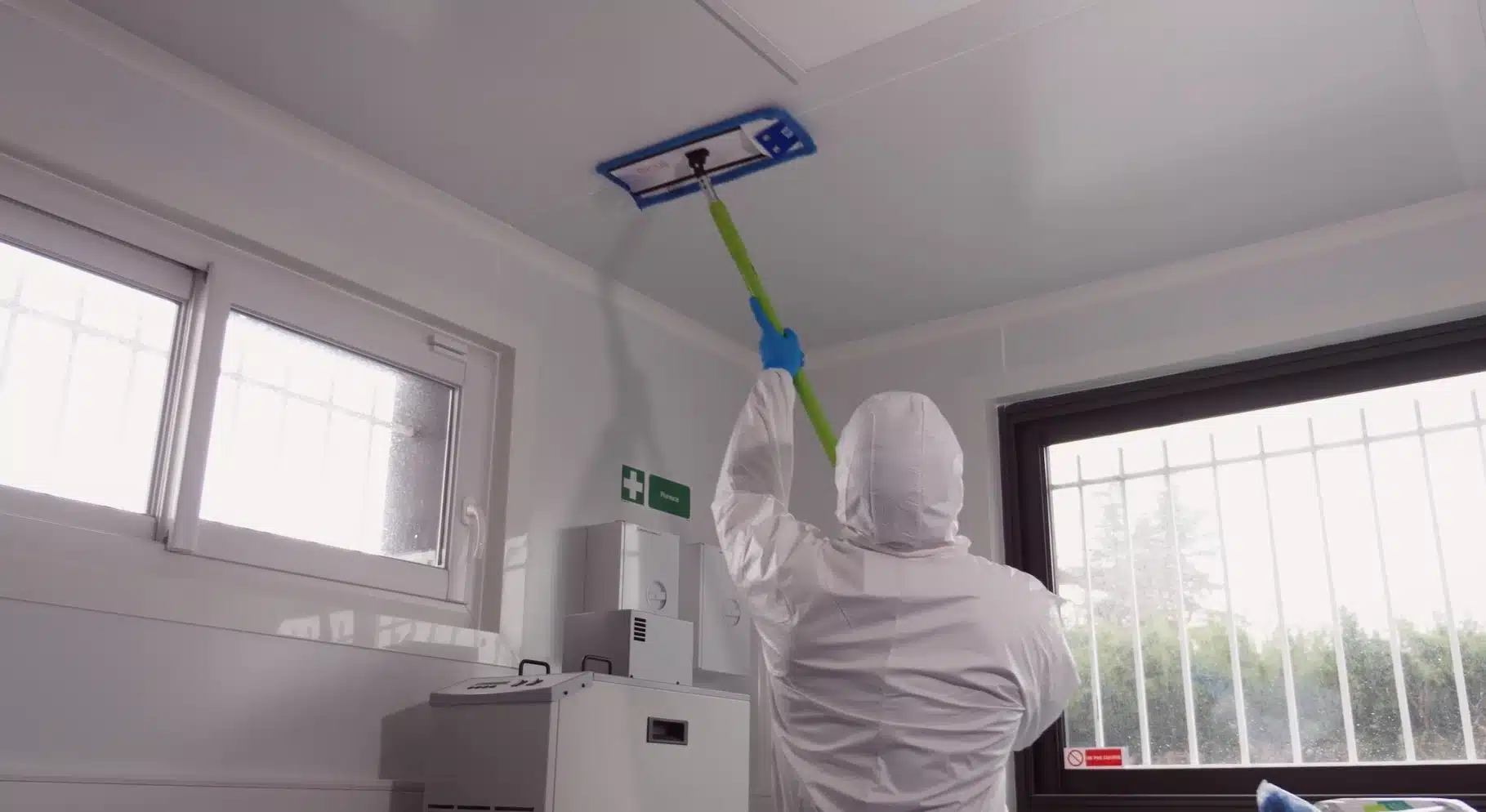
- From top to bottom: Due to the sedimentation of particles, cleaning should always start with the upper surfaces and end with the floor.
- From cleanest to dirtiest: This progression avoids contaminating areas that have already been cleaned.
- From bottom to front: To avoid walking on previously treated surfaces.
In healthcare establishments, particularly in hospital rooms, the principle of cleaning from the areas furthest away from the bed to those closest to it is also applied, with the bed representing a particularly sensitive area. At the same time, we proceed from the least touched surfaces to frequent points of contact such as door handles and light switches.
Risk zones: classification and requirements
To adapt protocols to specific needs, premises are classified according to their level of infectious risk. This classification guides the choice of methods, frequencies and products to be used:
- Zone 1 (minimal risk): Halls, administrative offices, technical services, corridors, waiting rooms. Daily maintenance with damp dusting and simple detergents is generally sufficient.
- Risk zone 2 (medium risk): Generally areas such as sterilization, maternity wards, psychiatry. Cleaning requires an alternating detergent or detergent-disinfectant.
- Risk zone 3 (severe risks): Intensive care, intensive care, emergency, surgery, medicine. Daily or several times daily maintenance with a detergent-disinfectant is required.
- Risk zone 4 (very high risk): Operating theater, transplant department, burn unit. These areas require daily biocleaning with specific detergent-disinfectants.
This methodical classification makes it possible to direct resources where they are most needed, while guaranteeing a level of hygiene appropriate to each environment. In addition, the protocol recommends always starting with the highest-risk premises and ending with those presenting the lowest infectious risk.
The fundamental principles of bio-cleaning form a rigorous scientific framework. When correctly applied, it can significantly reduce the risk of microbial contamination in sensitive environments. IGIENAIR operates in classified zones (2, 3, 4).
The step-by-step biocleaning protocol
The bionetting protocol is a precise sequence of operations designed to achieve optimum levels of hygiene in sensitive environments. Unlike ordinary cleaning, this method follows a rigorous procedure that must be respected to guarantee effective elimination of micro-organisms. Each stage plays a specific role in this process.
1. Preparation and initial decontamination (pre-cleaning phase)
Before any in-depth intervention, our teams carry out a preliminary dusting and residue removal phase. This phase is designed to remove visible particles, dust and coarse dirt from surfaces. It is essential to minimize the risk of contaminants spreading, and effectively prepare spaces for further cleaning. By removing macroscopic impurities, this step creates an environment conducive to the application of subsequent disinfection protocols. This phase significantly reduces the initial microbial load and limits interference during subsequent steps. It is particularly crucial in sensitive environments, where initial cleanliness directly influences the effectiveness of subsequent treatments.
2. Thorough cleaning and targeted disinfection (technical cleaning phase)
Our experts then intervene with specialized detergents and disinfectants, selected according to current standards and the specific characteristics of the surfaces to be treated. Every nook and cranny is meticulously cleaned to eliminate pathogenic micro-organisms (bacteria, viruses, fungi) and organic residues. The protocols used comply with the requirements of environments with high sanitary constraints, such as the pharmaceutical, agri-food or medical industries.
Key points:
- Use of enzymatic detergents or detergent-disinfectants for combined action.
- Application of validated techniques to guarantee uniform coverage and avoid missed areas.
- Respect of contact times required for optimal disinfection.
This step ensures not only visible cleanliness, but also microbiological hygiene to reduce the risk of cross-infection or residual contamination.
3. Terminal disinfection by fogging (overall treatment of spaces)
To complete the process, a dry or wet mist disinfection method is deployed. This technique diffuses a disinfectant in the form of micro-droplets into the air and onto all surfaces, including hard-to-reach areas (ceilings, corners, equipment). The product is deposited uniformly, providing 360° coverage and neutralizing persistent infectious agents.
This method allows :
- Effective against airborne and surface pathogens, including enveloped viruses and resistant spores.
- Adaptability to different types of premises (clean rooms, hospital rooms, medical transport vehicles).
- Traceability of interventions using biological or chemical indicators, if required.
This approach is often used in conjunction with manual cleaning to ensure complete disinfection, particularly in sterility-critical environments.
Specific methods: steaming, scooping, pushing
Several techniques can be employed, depending on the configuration of the site. The «sculling» method is recommended for cluttered surfaces. The «push» method is suitable for open spaces. Steam bioneting is an environmentally-friendly alternative that uses high temperature (120-160°C) and pressure (4-6 bars). It replaces the chemical action of products, while retaining similar effectiveness.
Frequency and organization by zone
The frequency of biocleaning varies according to the level of infectious risk in the areas concerned. Very high-risk areas (level 4), such as operating theatres, need to be cleaned several times a day, while moderate-risk areas can be cleaned just once a day. The organization always follows a precise logic: start with the least contaminated areas, clean from the cleanest to the dirtiest, and proceed from top to bottom.
Equipment and products used for biocleaning
Effective bio-cleaning requires the use of specialized equipment and appropriate products. Equipment plays a crucial role in reducing the risk of cross-contamination, and guarantees optimum results with every intervention.
Cleaning cart: clean/dirty organization
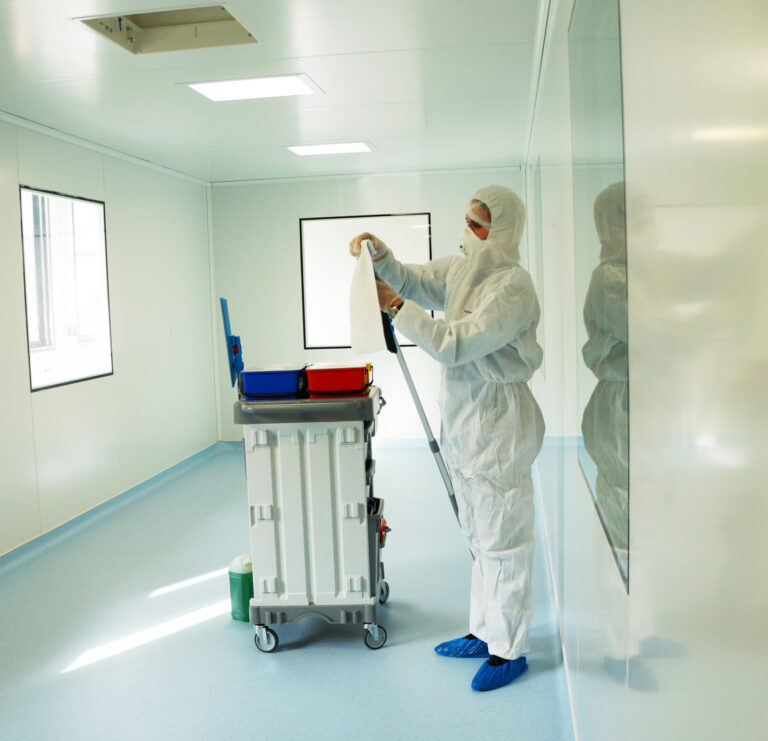
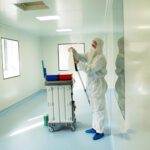
The bi-cleaning cart is the central element of any intervention. Its ergonomic design allows methodical organization, with strict separation between clean and dirty areas. The clean area contains stocks of clean mops and headbands, cleaning products and personal protective equipment, while the dirty area contains containers for used headbands and waste garbage cans. This strict separation prevents cross-contamination. What's more, the cart itself is decontaminated before each on-site intervention. It is packaged to avoid any pollution during transport between the IGIENAIR agency and the customer site.
Types of cloths and headbands
Wipes and mops come in two main categories: reusable and single-use. Microfiber models are particularly recommended for their superior ability to capture dirt and bacteria thanks to their enhanced mechanical action. In high-risk areas, or where additional precautions are required (such as for Clostridium difficile), single-use models are preferred.
Products: detergents, disinfectants, EN standards
Several types of products are required for bio-cleaning: detergents, disinfectants, detergent-disinfectants and sometimes descalers. Disinfectants must comply with specific European standards (EN) to guarantee their effectiveness: EN 13727 for bactericidal action, EN 13624 for fungicidal action and EN 14476 for virucidal action. For high-risk surfaces, service technicians check the spectrum of activity of the products used. When applying, recommendations include scrupulously respecting dosages, spraying the product onto wipes rather than directly onto surfaces to limit aerosolization, and respecting the indicated contact time.
Using the dilution unit
The dilution unit represents a major innovation in professional bio-cleaning. This system guarantees a perfectly balanced mixture of water and concentrated products, ensuring optimum efficiency and avoiding wastage. Its operation is based on a technology that automatically adjusts the flow rate to obtain the ideal concentration. However, particular vigilance is required: the integrity of the hoses must be checked regularly, and the water pressure must be sufficient for accurate dilution.
Best practices and hygiene rules to follow
Hygiene rules are an essential pillar of bio-cleaning. Beyond techniques and products, it's human behavior that guarantees the effectiveness of procedures and minimizes the risk of contamination in sensitive environments.
Hand hygiene before and after surgery
Hand washing is the first barrier against the spread of micro-organisms. Before and after each bio-cleaning operation, careful disinfection with a hydro-alcoholic product or antiseptic soap is essential. This simple but fundamental practice considerably reduces the risk of cross-contamination between different areas.
Personal protective equipment (PPE)
For all biocleaning protocols, the wearing of appropriate PPE is mandatory. Gloves, gowns, overcoats, overboots and FFP2 masks protect both personnel and the environment. To prevent the transmission of germs, workers change their equipment between each high-risk area.
Traceability and practice assessment
The definition of bio-cleaning necessarily includes an evaluation dimension. Each intervention must be recorded in a logbook, indicating date, time, area treated and products used. In addition, regular visual checks and microbiological sampling are used to verify the effectiveness of procedures and adjust practices if necessary.
Ongoing training and awareness-raising
Bio-cleaning requires specific skills that are constantly updated. Solid initial training, followed by regular refresher sessions, is essential to maintain an optimum level of expertise. In this way, staff stay abreast of the new techniques, products and standards that are driving developments in bio-cleaning.
Conclusion
All in all, the biocleaning is much more than a simple maintenance procedure; it's a scientific and methodical approach that's essential for guaranteeing sanitary safety in sensitive environments. The fundamental principles of the Sinner Circle (temperature, mechanical action, chemistry and time) form the theoretical basis of this rigorous practice.
Unlike conventional cleaning, bionetting follows a strict protocol that generally comprises three essential stages: greying, blasting and disinfection. Properly executed, this method considerably reduces the presence of pathogenic micro-organisms.
Effective biocleaning also depends on the observance of precise rules, in particular the progression from clean to dirty, from top to bottom, and the use of appropriate equipment. A well-organized ultra-cleaning cart, specific wipes and strips, and products that comply with European standards all play a decisive role in this process.
Of course, the rigorous application of personal hygiene rules, such as hand disinfection before and after each procedure, remains just as important as the technique itself. To master these complex procedures, staff in charge of biocleaning must receive appropriate ongoing training.
So, whether you work in a healthcare establishment, a laboratory or any other sensitive environment, you can now understand why bio-cleaning is an essential link in the infection prevention chain. Its impact goes far beyond mere visual cleanliness: it contributes directly to the protection of public health and the safety of vulnerable people.
FAQs
What is bio-cleaning and how does it differ from conventional cleaning?
Bio-cleaning is a method that combines cleaning and disinfection to reduce biological contamination of surfaces. Unlike conventional cleaning, which focuses on removing visible dirt, bio-cleaning aims to eliminate pathogenic micro-organisms to prevent the spread of infection.
What are the basic principles of bio-cleaning?
The fundamental principles of bio-cleaning are based on Sinner's circle, which comprises four factors: temperature, mechanical action, chemistry (products used) and action time. These elements must be balanced to achieve effective cleaning.
In what types of environment is bio-cleaning particularly important?
Bio-cleaning is essential in sensitive environments such as hospitals, clinics, retirement homes, nursing homes, research laboratories and the food industry. These environments require a high level of hygiene to prevent the spread of infections and guarantee the safety of occupants.
What are the main steps in a bio-cleaning protocol?
A typical bio-cleaning protocol comprises three main steps: 1) cleaning with a detergent to remove visible soiling, 2) rinsing to remove residues, and 3) disinfection or the use of a 2-in-1 product to eliminate remaining micro-organisms.
What are the best practices for bio-cleaning?
Good practices include hand hygiene before and after each intervention, the wearing of appropriate personal protective equipment (PPE), traceability of interventions, and ongoing staff training. It is also important to respect the order of cleaning (clean to dirty, top to bottom) and to use the appropriate equipment and products.